China Top Freight Lift How to Calculate Load Capacity?

Time:2026-09-21 Author:Sienna
0%

China’s freight lift market serves factories, warehouses, shopping centers, and logistics hubs. Capacity decisions affect safety, efficiency, energy use, and long-term maintenance costs. The 2024 MHI Annual Industry Report emphasizes continuing investment in automated material handling and warehouse infrastructure. That trend increases demand for accurately specified freight lifts.

The practical question is not only “how much can the platform hold?” Engineers must ask how to calculate the load capacity of a freight lift under real operating conditions. A 1,000-kilogram pallet may arrive with a 120-kilogram steel trolley. Add packaging, tools, uneven loading, and possible impact during entry. The total working load can rise quickly. Door dimensions and platform size also influence usable capacity.

A basic assessment begins with the combined mass of goods, operators, carts, and handling equipment. Engineers then verify the result against the manufacturer’s rated load, loading method, stopping accuracy, and duty cycle. ISO 8100-1:2019 and ISO 8100-2:2019 provide widely recognized safety principles for lift design and verification. In China, GB/T 7588.1-2020 and GB/T 7588.2-2020 are important technical references for lift safety requirements. These standards should guide the final design, not a convenient online formula.

A neat calculation is not enough. Site conditions often expose weak assumptions. This article explains the main variables, practical formulas, and verification steps for selecting a reliable China freight lift. It also highlights common calculation mistakes that may look harmless during planning. They are not.
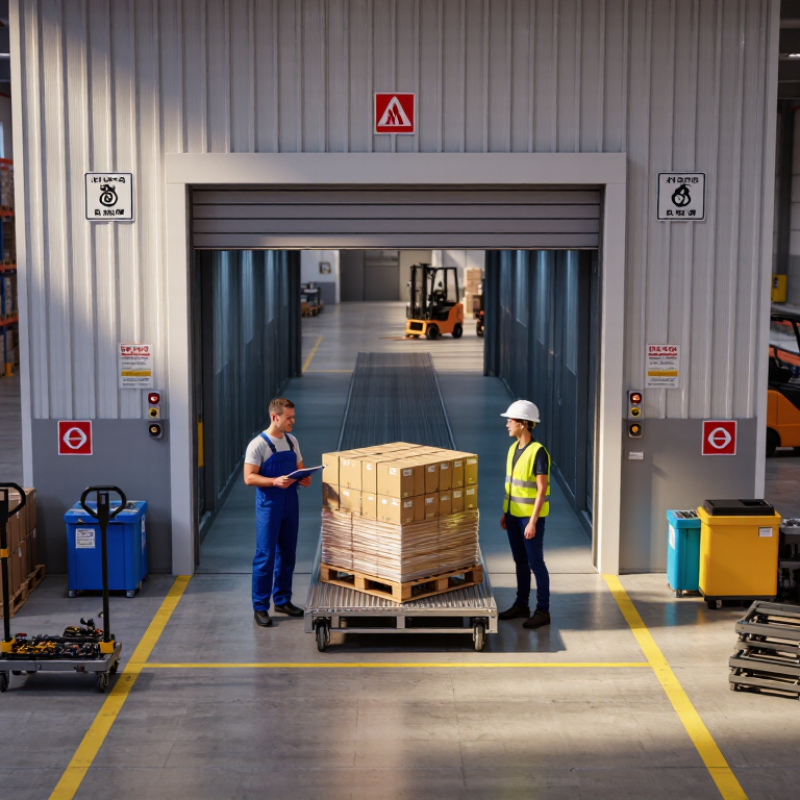
China Top Freight Lift How to Calculate Load Capacity?

What Is a Freight Lift Load Capacity?

What Is a Freight Lift Load Capacity?

A freight lift’s load capacity is the maximum safe weight it can carry, including goods, pallets, cages, and handling equipment. It is not the weight of the goods alone. EN 81-31 and ISO 4190-1 require the rated load, platform size, and intended use to be clearly defined. These standards also distinguish goods-only lifts from lifts carrying people.

A practical calculation starts with the heaviest operating combination. Add the product load, pallet weight, trolley weight, and any lifting attachment. For example, 1,200 kg of goods plus a 120 kg pallet and a 180 kg electric trolley equals 1,500 kg. The selected lift should exceed this figure after the manufacturer checks structural, motor, rope, brake, and floor-load limits. Do not simply divide motor power by weight.

Real sites are less tidy. Loads may shift during travel. A pallet can strike the entrance. EN 81-20 safety principles and local inspection rules therefore require protection against uneven loading and unsafe operation. A conservative engineer may specify a 2,000 kg freight lift for a calculated 1,500 kg working load, depending on traffic frequency and loading method. This is not a universal safety margin.

The U.S. Bureau of Labor Statistics reported 885 fatal workplace injuries in transportation and material-moving occupations in 2023. The figure is broader than lift accidents, but it shows why capacity labels and documented inspections matter. A site survey should verify clearances, door width, pit conditions, and the actual equipment used. Estimates alone are imperfect.

Which Factors Determine the Required Load Capacity?

Required load capacity starts with the heaviest planned load, not the average shipment. A freight lift must carry goods, pallets, containers, and any loading equipment inside the car. For example, 1,000 kg of cartons plus a 180 kg pallet and 120 kg trolley already requires 1,300 kg of useful capacity. Do not ignore small items.

Load distribution also matters. A steel coil placed near one corner creates more stress than evenly arranged cartons. The lift design should consider the load’s center of gravity, dimensions, stacking height, and entry method. Frequent cycles, rapid starts, long travel distances, and heavy-duty doors can influence the required specification. Dust, humidity, temperature changes, and uneven floors may affect operation as well.

Real sites are rarely tidy. My early estimates would have missed the trolley weight without a physical loading check. Measure the heaviest pallet, weigh handling tools, and observe how workers position each load. A qualified lift engineer should verify the calculation, structural loads, safety margin, and applicable local standards. Capacity should never be chosen from cargo weight alone. A practical allowance may be needed for variation, but adding an arbitrary percentage is not a reliable engineering method. The final rating must match actual use, inspection requirements, and the lift’s intended duty cycle.

How to Calculate the Total Freight Lift Load

China Top Freight Lift: How to Calculate the Total Freight Lift Load

The total freight lift load includes every item inside the car. Use this formula: cargo weight + pallet weight + container weight + attachments + permitted occupants. For example, a 1,000-kilogram lift carries 720 kilograms of goods, an 80-kilogram pallet, a 100-kilogram cage, and two 75-kilogram workers. The total is 1,050 kilograms. That lift is overloaded. The floor scale matters.

A freight lift’s rated capacity normally refers to the permitted load inside the car. It does not equal the car’s own dead weight. Structural calculations also consider the car frame, ropes, counterweight, braking forces, and impact conditions. EN 81-20 and ASME A17.1 require these design factors to follow the lift’s certified engineering specification. Do not add an invented safety multiplier to the rated capacity. Confirm the required factor with a qualified lift engineer. The U.S. Bureau of Labor Statistics recorded 5,283 fatal workplace injuries in 2023, while the International Labour Organization estimates 2.93 million work-related deaths annually. These figures are not freight-lift statistics, but they reinforce disciplined load control. In practice, read the nameplate, weigh uncertain items, and record the heaviest loading combination. A tidy spreadsheet can still be wrong. Door width, uneven pallets, and shifting cargo deserve a second check.

China Top Freight Lift: How to Calculate Load Capacity?

The total freight lift load is calculated by adding the cargo weight, pallet or container weight, operator and tools, and packaging or handling accessories. The combined load must remain below the lift's rated capacity.

In this example, the total calculated load is 2,050 kg: 1,800 kg of cargo, 120 kg for the pallet, 80 kg for the operator and tools, and 50 kg for packaging. With a rated capacity of 2,500 kg, the remaining capacity is 450 kg. Always follow the freight lift manufacturer's rated load, loading method, and safety requirements.

How to Select a Safe Capacity Rating

China Top Freight Lift How to Calculate Load Capacity?

Selecting a safe freight lift capacity starts with the heaviest planned load, not the average shipment. Add the pallet, goods, trolley, and people who may enter the platform. For example, an 800-kilogram pallet, a 120-kilogram cart, and a 90-kilogram operator create a 1,010-kilogram working load. A 1,250-kilogram rated lift may be more suitable than a 1,000-kilogram model.

Do not treat the rated capacity as a breaking limit. It is the maximum permitted working load under specified conditions. Forklift entry, sudden braking, uneven pallets, and off-center cargo can create extra forces. These details matter. Review the lift layout, travel height, platform size, loading method, and daily operating cycle with a qualified lift engineer. The installation guide and inspection requirements should also be checked before selection.

A practical site assessment can reveal risks that a spreadsheet misses. Measure the narrowest doorway and watch how a loaded trolley turns. Confirm that the floor can support the imposed loads and that operators can see the platform clearly. Never increase capacity by guesswork or by adding a random percentage. A neat calculation can still be wrong. Leave suitable working margin, then select the next appropriate standard rating after professional review. Recheck the rating when cargo types, pallet sizes, or handling equipment change. Five minutes of observation may expose a serious assumption.

How to Verify Capacity Before Installation

China Top Freight Lift: How to Calculate Load Capacity

How to Verify Capacity Before Installation

A freight lift’s capacity must cover the complete working load, not only the goods. Add the product, pallet, cage, trolley, and any permitted operator. For example, 1,200 kilograms of goods plus a 180-kilogram pallet and 120-kilogram trolley requires at least 1,500 kilograms of usable capacity. Do not round down.

Check the heaviest expected load first. Then examine its size, center of gravity, and loading method. A dense machine may fit within the weight limit but overload one platform area. Measure axle loads when forklifts or pallet trucks enter the lift. Confirm the platform’s distributed and concentrated load ratings with the technical drawings.

Before installation, request the rated-load certificate, structural calculations, and inspection requirements. A qualified engineer should compare these documents with the actual shaft, pit, overhead space, floor strength, and anchoring points. Site conditions often differ from early drawings. That detail matters.

Use calibrated test weights during commissioning. Test the doors, controls, brakes, emergency systems, and stopping accuracy under the approved load. Never treat a successful empty run as capacity verification. It proves very little.

A common mistake is adding an arbitrary safety margin and calling the design safe. The margin must follow applicable standards and the lift’s engineering data. Recheck future loads too. Equipment changes, and memory is not a calculation.

China Top Freight Lift: How to Calculate Load Capacity and Verify Capacity Before Installation
Verification Dimension Calculation or Requirement Example Data Result / Installation Check
Goods load Record the maximum mass of goods carried in one lift cycle. 1,800 kg of packaged goods Use the heaviest expected load, not the average load.
Pallet or container mass Add the tare mass of every pallet, cage, bin, or container transported. 1 pallet × 35 kg 35 kg must be included in the lifting load.
Handling equipment mass Add the operating mass of a pallet truck, trolley, or other equipment entering the car. Electric pallet truck: 420 kg Equipment mass is part of the imposed load unless specifically excluded by the design.
Personnel mass Include operators or passengers when personnel access is permitted. 2 people × 80 kg = 160 kg Use the applicable local design value when the authority requires a specified person load.
Total operating load Goods + pallet/container + handling equipment + personnel 1,800 + 35 + 420 + 160 kg 2,415 kg
Planning allowance For preliminary selection only, apply an agreed allowance for load uncertainty; do not substitute it for code-based safety factors. 10% planning allowance 2,415 × 1.10 = 2,656.5 kg preliminary selection load
Recommended nominal capacity Select the next available rated capacity above the verified operating load and confirm it with the applicable lift standard. Available nominal capacities: 2,500 kg, 3,000 kg 3,000 kg is the suitable preliminary choice; final approval requires engineering verification.
Point-load verification Check the heaviest wheel or support reaction, not only the evenly distributed load. Equipment mass: 420 kg; 4 wheels; assumed equal static distribution Approx. 105 kg per wheel before dynamic effects. Confirm actual wheel loads and floor limits.
Load distribution Verify that the center of gravity remains within the car floor loading area. Pallet footprint: 1,200 × 1,000 mm; car floor: 2,000 × 2,500 mm Floor area is adequate geometrically, but structural point-load approval is still required.
Car size and clear opening Confirm that goods and equipment can enter without contacting doors, walls, or safety devices. Door opening: 1,400 × 2,100 mm; equipment width: 1,100 mm Nominal clearance is 150 mm per side at the narrowest opening; verify turning clearance on site.
Hoistway and pit conditions Measure shaft width, depth, overhead clearance, pit depth, access, ventilation, and drainage. Measured dimensions must match the approved layout drawing. Do not install from nominal dimensions alone; use a signed site survey.
Building structural capacity The building engineer must verify reactions at guide rails, brackets, beams, landing supports, and foundations. Obtain allowable loads and reaction forces from the lift design documents. Rated car capacity alone does not prove that the building can support the installation.
Rated capacity marking Check that the rated load, number of persons where applicable, and identification plate match the approved documents. Required rated capacity: at least 3,000 kg The nameplate and controller settings must not show a lower value than the approved design.
Overload protection Confirm the lift has a tested overload detection and prevention function where required by the governing code. Functional test at commissioning Test results should be recorded in the commissioning and inspection documents.
Final acceptance Use the applicable national and local regulations, approved drawings, risk assessment, and inspection procedure. Documentation reviewed by the qualified installer, engineer, and inspection authority. Install and operate only after all capacity, structural, safety, and statutory checks are passed.

FAQS

What does a freight lift’s load capacity include?

It includes goods, pallets, cages, trolleys, attachments, and permitted occupants. It excludes the lift car’s own dead weight. The floor scale matters.

How can I calculate the total load?

Add cargo, pallet, container, equipment, attachments, and occupants. For example, 1,200 kilograms of goods plus 300 kilograms of equipment equals 1,500 kilograms.

Can a lift rated for 1,000 kilograms carry 1,050 kilograms briefly?

No. The rated capacity is the maximum permitted working load. A short trip does not make overloading safe. Do not guess.

Why should the selected capacity exceed the calculated load?

Loads can shift, pallets can strike doors, and carts can brake suddenly. A 1,500-kilogram working load may require a higher rating after engineering review.

Does motor power determine freight lift capacity?

No. Capacity also depends on the frame, ropes, brakes, platform, floor loads, and loading forces. Motor power alone is an incomplete calculation.

Should workers be included in the load calculation?

Yes, when people may enter the platform. Add their expected weight, even during goods handling. Two 75-kilogram workers add 150 kilograms.

What should a site survey check?

Measure door width, platform space, travel height, floor strength, pit conditions, and trolley turning space. Watch a loaded trolley move. Real sites are messy.

How often should the capacity assessment be reconsidered?

Recheck it when cargo types, pallet sizes, equipment, or loading methods change. A tidy spreadsheet can still be wrong. Five minutes of observation may reveal a serious assumption.

Conclusion

A freight lift’s load capacity is the maximum weight it can safely transport, including goods, pallets, containers, and any handling equipment inside the car. To understand how to calculate the load capacity of a freight lift, first identify the heaviest expected load and add the weight of packaging, lifting tools, and other materials that may travel with it. Consider important factors such as load distribution, lift dimensions, loading frequency, travel height, operating environment, and the type of goods being moved. Uneven or concentrated loads may require a higher capacity rating than evenly distributed cargo.

After calculating the total expected freight weight, add a suitable safety margin without exceeding the building’s structural and operational limits. The selected capacity should match actual working conditions rather than average loads. Before installation, verify the calculation with technical drawings, structural assessments, equipment specifications, and applicable safety requirements. A professional inspection and load test should confirm that the lift, supporting structure, doors, controls, and braking systems can operate safely at the intended rating.

Sienna

Sienna

Sienna is a skilled marketing professional with a deep expertise in our company’s core products and services. With a passion for innovation and detail, she plays a pivotal role in crafting insightful blog posts that not only highlight the unique features of our offerings but also provide valuable......